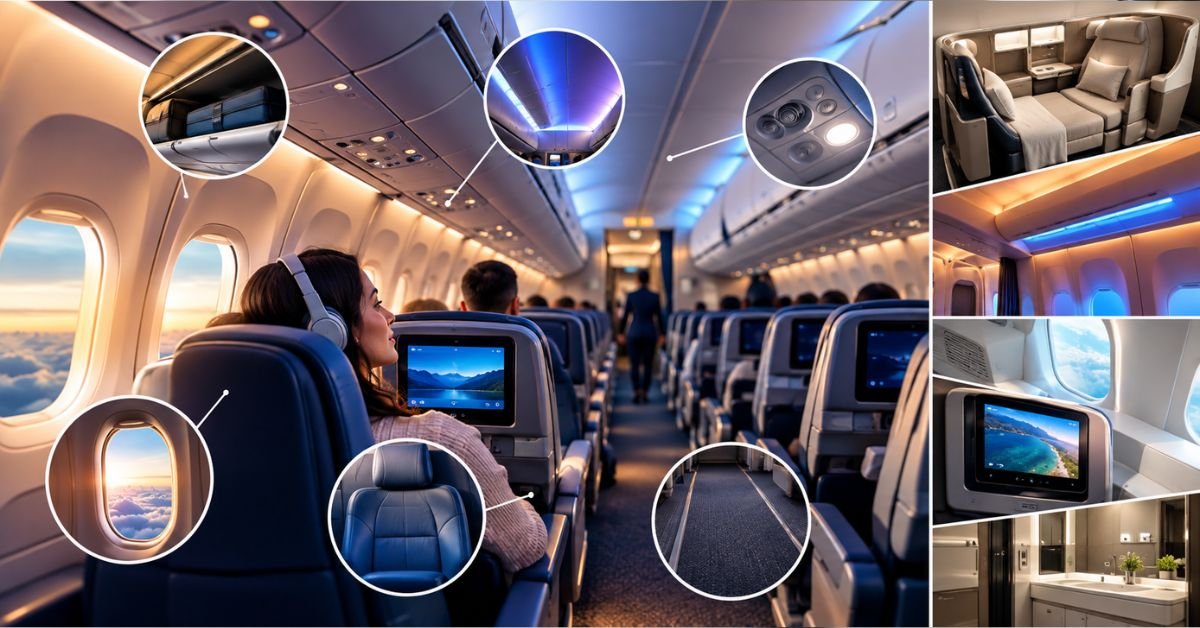
Ask a traveler about the aircraft they flew on last month and they probably won’t remember the engines or the model. Ask how the flight felt, though, and the answers come easily. The seat was fine, or it wasn’t. The cabin felt calm, or cramped. There was somewhere to put a bag, or there wasn’t. Nearly all of that comes down to the interior, and it’s a big part of how people remember an airline once the trip is over.
Airplane interior design is the discipline behind those impressions. It draws on engineering, ergonomics, materials science, lighting, acoustics, and brand identity, and it has to produce a space that is light, safe, durable, and pleasant to sit in for hours. Here’s a closer look at what cabin design involves and how its pieces add up to a feeling of comfort.
What Aircraft Cabin Design Covers
Few environments are as tightly constrained as an aircraft cabin. It’s narrow, curved, and pressurized, and it operates under strict weight and safety rules. Even so, it has to serve hundreds of people of different heights, ages, and expectations. Designers can’t just add room, so every centimeter has to justify itself. That pull between limited space and high expectations is what makes the field so interesting.
When people talk about cabin design, they usually mean everything a passenger sees and touches: seats, sidewalls, ceiling panels, overhead bins, lavatories, galleys, flooring, and lighting. Beneath those surfaces sits a less visible layer of wiring, air distribution, insulation, and structure. If you’d like to go deeper into the subject, JETLINER CABINS, Aircraft cabin design is an aviation website focused on airplane interior design and the passenger experience, and it’s a good place to see how these components relate to one another. Each choice also has to clear a long list of certification requirements, which is why interior projects often take years rather than months.
The upshot is that looks and function can’t be pulled apart. A handsome sidewall panel that adds weight, collects dust, or fails a flammability test is a bad design, however good it looks in a rendering.
Seating: Where Comfort Is Won or Lost
Passengers spend the entire flight in one place, and that place is the seat. It’s no surprise that seating gets more scrutiny than any other part of the cabin.
Dimensions and ergonomics
Pitch, width, recline, and headrest shape all matter, but the numbers only tell part of the story. Two seats with the same pitch can feel quite different depending on how the seatback is sculpted, how thick the cushioning is, and where the tray table sits. A slim seatback, for instance, can free up knee room without changing the distance between rows.
Support over long stretches
A seat that feels fine for twenty minutes can become worn after five hours. Good designers think about how pressure is distributed, how the lower back is supported, and how a body shifts over time. Foam density, fabric breathability, and adjustable headrests all play a part, and all of them have to fit within tight weight limits.
Personal space and privacy
In premium cabins the emphasis moves toward privacy and flexibility: lie-flat beds, sliding doors, and seats angled to limit eye contact with the passenger next door. The economy has its own small versions of this. Armrest design, dividers, and storage pockets all affect how personal a seat feels.
Lighting, Color, and Atmosphere
Lighting is one of the most effective tools in modern cabin design. LED systems let airlines change color temperature and brightness during a flight, and passengers notice the difference.
A soft, warm glow at boarding feels welcoming rather than clinical. Brighter, cooler light during meal service makes it easier to see and move around. Amber tones in the evening signal that it’s time to rest, and a gradual brightening before landing helps people wake up without a jolt. On long-haul routes, where time zones blur together, this kind of lighting helps passengers keep their bearings.
Color works alongside light. Neutral palettes make a cabin look cleaner and more spacious, while accent colors reinforce an airline’s identity. Because surfaces are lit from odd angles and viewed down a long, narrow tube, a color that looks balanced on a sample board can behave very differently once installed. That’s why designers test materials in full-scale mockups before committing.
Sound, Air, and Temperature
Passengers rarely praise a quiet cabin, but they notice a loud one right away. Noise comes from the engines, airflow along the fuselage, and the environmental control system, and it adds to fatigue over a long flight. Insulation, damping materials, and carefully shaped air outlets all help keep it down.
Air quality and temperature matter just as much. A cabin needs steady ventilation, comfortable humidity as far as the system allows, and a way to avoid obvious hot and cold spots. Individual air vents and well-chosen seat materials also give passengers a small sense of control, which does more for comfort than you might expect in a shared space.
Space, Storage, and Flow
A cabin doesn’t only have to look good when it’s empty. It has to work while hundreds of people board, move around, and get off again.
Overhead bins are a good example. Their size and shape determine how quickly luggage gets stowed, and a poorly designed bin can slow boarding and sour the mood before the aircraft has left the gate. Aisle width, galley placement, and lavatory locations affect how smoothly passengers and crew move through the space. Designers often study boarding patterns and service routines to find where congestion builds up and whether a small layout change could ease it.
Perceived space matters too. Curved ceilings, higher sidewalls, and large windows can make a cabin feel roomier than its measurements suggest. Dimmable windows and clear sightlines also keep passengers connected to the world outside, which many people find calming.
Materials, Weight, and Sustainability
Every material in a cabin has to meet demanding criteria. It must resist fire, put up with daily cleaning, last for years, and weigh as little as possible. Weight is a constant concern because extra kilograms mean extra fuel, so designers keep looking for lighter alternatives to traditional materials.
That has led to wide use of composites, advanced plastics, and thin, strong textiles. Airlines and suppliers are also exploring recycled and lower-impact materials for carpets, upholstery, and trim. The difficulty is balancing sustainability against safety rules, durability, and cost. A material that looks promising on paper still has to prove it can handle years of heavy use.
Cleaning is a practical concern of its own. Surfaces need to survive frequent disinfecting without cracking, fading, or turning sticky, and smooth, seamless finishes help a cabin look fresh between flights.
Safety and Certification Come First
However appealing a cabin concept is, it has to be certified before passengers can use it. Interiors are subject to rules covering flammability, emergency evacuation, seat strength, and the placement of exits, signage, and safety equipment. Seats must withstand significant forces, and the layout must let passengers leave the aircraft quickly in an emergency.
For designers, that means creativity works inside a framework. The best interiors don’t fight the requirements; they absorb them so well that passengers barely notice. A well-placed exit sign, a clearly marked aisle, or an intuitive seatbelt buckle is designed doing its job quietly.
Brand Identity Inside the Cabin
For an airline, the cabin is the most direct way to deliver on its brand promise. A budget carrier may prioritize efficiency, higher density, and easy cleaning. A premium operator may lean toward privacy, tactile materials, and a more residential feel. Signature colors, custom lighting scenes, uniforms, and even subtle upholstery patterns help passengers recognize and remember an airline.
The most successful interiors are consistent. When seats, lighting, materials, and service touchpoints all tell the same story, the experience feels deliberate rather than pieced together.
Where Cabin Design Is Heading
A few trends are shaping the next generation of interiors:
- Personalization: Passengers increasingly expect to control lighting, temperature, and entertainment from their own seat.
- Wellbeing: Designers are paying closer attention to circadian-friendly lighting, quieter cabins, and calmer visual environments.
- Flexible layouts: Modular components make it easier for airlines to reconfigure cabins as route needs change.
- Lighter, cleaner materials: Ongoing research aims to cut weight and environmental impact without compromising safety.
- Connectivity: Reliable wireless access and device integration are now a baseline expectation rather than a perk.
None of this replaces the fundamentals. A cabin still has to be safe, comfortable, and efficient. What’s changing is how much thought goes into the emotional side of flying: the sense of calm, control, and care that a well-planned interior can create.
Conclusion
Aircraft interiors are built from panels, fabrics, foam, and light fixtures, but what they really deliver is an experience. Every decision, from the contour of a seatback to the color of the evening lighting, shapes how passengers feel between boarding and arrival. It’s a large part of why airlines invest so heavily in their cabins, and why passengers so often remember a flight by its interior rather than its destination.
For travelers, designers, and aviation enthusiasts alike, paying closer attention to the cabin is a rewarding way to appreciate how much thought goes into a journey that, at its best, feels effortless.
FAQs
Q1. What are the future trends in aircraft cabin design?
Lighter recyclable materials, AI-adjusted lighting and air quality, modular seats that reconfigure between routes, touchless and app-controlled amenities, and fully flat-bed seats even in premium economy. Some concepts use screen-based “window” ceilings.
Q2. What are the three main phases of aircraft design?
- Conceptual design: defining the mission, size, and rough shape.
- Preliminary design: refining aerodynamics, structure, and performance, then freezing the configuration.
- Detailed design: specifying every part, system, and manufacturing process, then testing and certifying.
Q3. What are the current trends in aircraft design?
Fuel efficiency leads: composite airframes, long slender wings, and next-generation engines. Alongside these are hybrid-electric and hydrogen research, digital twins for testing, and more autonomous flight systems.
Q4. Who designs aircraft interiors?
Interior design studios, industrial designers, human-factors engineers, and certification experts. Airlines set the vision, while suppliers like Collins Aerospace, Safran, and Diehl build the seats, galleys, and lighting, all within strict safety rules.
Q5. What do you call people who design airplanes?
Aerospace engineers (or aeronautical engineers). Specialties include aerodynamicists, structural engineers, and avionics engineers working together as a design team.
SEE MORE INFORMATION ON : RESOVENT