
Quick Answer: “CertVault” Isn’t One Product — It’s Several
Here’s the thing nobody tells you upfront: “CertVault” is a name used by at least five different, unrelated software products.
If you searched this term expecting one clear answer, that’s normal. It’s also why you might be on your third Google result trying to figure out which “CertVault” actually matches what you need.
This guide breaks down every major platform using the CertVault name, tells you who it’s actually built for, and helps you land on the right one in under two minutes.
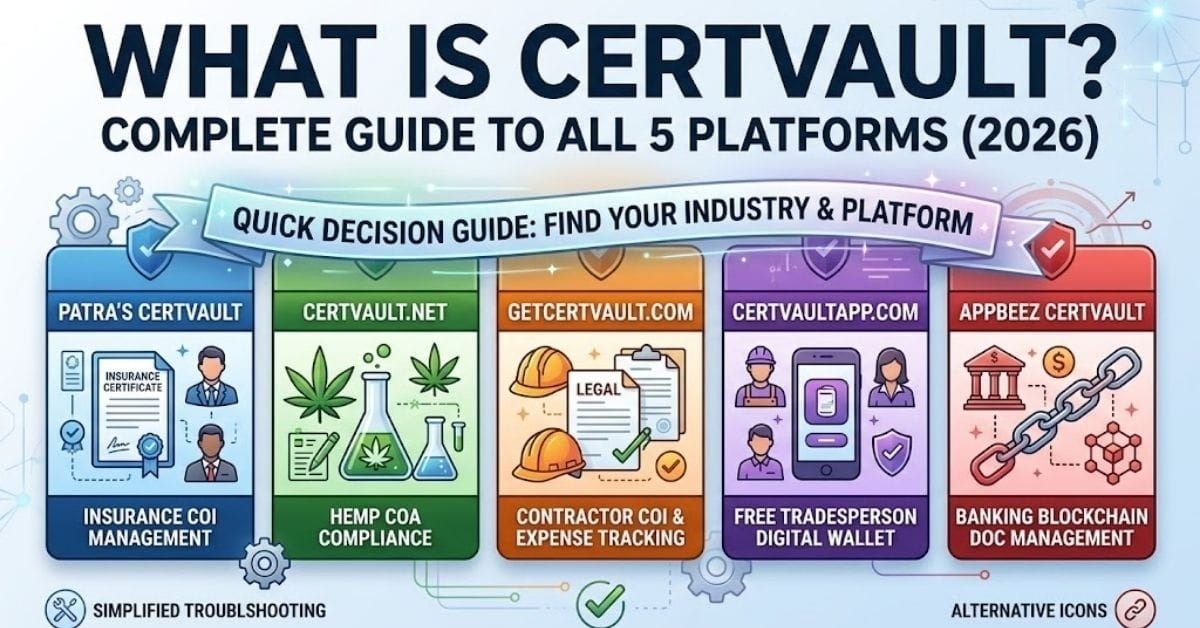
The five main platforms called CertVault:
- Patra’s CertVault — Certificate of Insurance (COI) management for insurance brokers and agencies (the largest and most established)
- CertVault.net — Certificate of Analysis (COA) compliance tracking for hemp, CBD, and THC product sellers
- GetCertVault.com — Subcontractor COI collection and expense tracking for contractors
- CertVaultApp.com — A free personal digital wallet for tradespeople to store trade certifications
- AppBeez CertVault — White-label blockchain document management for banks and financial institutions
Let’s go through each one.
1. Patra’s CertVault: Certificate of Insurance Management for Brokers
If you work in commercial insurance and heard the term “CertVault” from a broker, carrier, or agency, this is almost certainly the one you mean.
What it does:
CertVault by Patra is a cloud-based repository for Certificates of Insurance (COIs). Brokers use it to issue, store, and deliver certificates to certificate holders instantly, instead of emailing PDFs back and forth every time a landlord or general contractor needs proof of coverage.
Scale and traction matter here. By 2023, the platform had surpassed 1.7 million digital certificates of insurance and signed up more than 75,000 companies as registered users. That’s not a niche tool it’s become infrastructure for a meaningful chunk of the commercial insurance industry. PR Newswire
Why it exists: Patra’s CEO framed the core problem directly tracking down certificate holder delivery information used to eat huge amounts of time, so CertVault built a nationwide database of holders, insureds, brokers, and carriers to eliminate that friction. cbinsights
Key features:
- Blockchain-backed certificate integrity — once a certificate is issued, the record can’t be silently altered
- Real-time delivery verification — brokers can confirm a certificate holder actually received and viewed the document, not just that an email was sent
- Certificate holder database — a certificate holder registered under one broker’s account is recognized across other brokers using CertVault, which cuts down on redundant onboarding
- Expiration tracking — automatic flags for certificates nearing their renewal date
Who owns it: Patra Corporation, an insurance outsourcing and technology company founded in 2005. CertVault is one of several trademarks the company holds, alongside PatraOne and PolicyCheckingAI.
Patra CertVault: Pros and Cons
| Pros | Cons |
|---|---|
| Massive network effect — certificate holders are shared across brokers | Primarily built for brokers/agencies, not individual policyholders trying to self-serve |
| Blockchain integrity prevents tampering after issuance | Full feature access typically requires your agency to be onboarded through Patra |
| Real-time delivery confirmation reduces “did they get it?” disputes | Less useful if your agency issues very low certificate volume |
| Backed by an established company (not a startup that might disappear) | Documentation and login support is agency-specific — there’s no generic public help center |
Common troubleshooting issues:
- Can’t log in as a certificate holder? You typically don’t need an account to view a certificate someone sent you — check the email link first before assuming you need to register.
- Certificate shows as “delivered” but the holder says they never got it? Check spam/junk folders first; blockchain delivery confirmation tracks the platform-side send, not whether the recipient’s inbox filtered it.
- Trying to find your agency’s CertVault portal? It’s typically accessed through your broker or agency directly, not through a public sign-up page — contact your agency admin rather than searching for a generic login URL.
2. CertVault.net: Certificate of Analysis (COA) Compliance for Hemp, CBD, and THC
Different industry, completely different problem. If you sell hemp, CBD, or THC products, “certvault” search results might point you here instead.
What it does:
This platform tracks Certificates of Analysis (lab test results confirming what’s actually in a product) for regulated cannabinoid products. The platform positions itself around a very specific pain point: helping retailers, distributors, and manufacturers maintain compliance while preventing merchant account shutdowns. Certvault
Why this matters more than it sounds: Payment processors and banks are notoriously trigger-happy about shutting down merchant accounts for hemp/CBD sellers who can’t produce current, valid lab testing documentation on demand. A missing or expired COA isn’t just a compliance headache — it can freeze your ability to process payments entirely.
Who it’s for: CBD/THC retailers, hemp product distributors, and manufacturers who need an audit-ready system for proving every batch was tested and passed.
Practical checklist if this is your situation:
- Confirm every SKU you sell has a current COA on file, not just the ones you remember to check
- Verify your COAs include testing for both cannabinoid potency AND contaminants (pesticides, heavy metals, residual solvents)
- Set renewal reminders before COAs expire — most testing is batch-specific, not annual
- Keep documentation accessible in case your payment processor requests it on short notice
3. GetCertVault.com: COI and Expense Tracking for Contractors
This one’s aimed at the other side of the insurance certificate relationship — general contractors managing subcontractors, rather than the brokers issuing the certificates.
What it does:
Instead of chasing subs for insurance paperwork every renewal cycle, this platform automates collection. According to the platform’s own description, you enter a subcontractor’s name and email, create a job, and CertVault sends subs a secure upload link with no account needed and nothing to download. CertVault
It goes beyond COIs. The platform also functions as a document-and-expense parser: snapping a photo of a receipt lets the system read the vendor, amount, and line items and categorize it automatically, and the same document parsing applies to COIs, W-9s, and lien waivers subs upload. CertVault
The pitch for tax season: rather than showing up to your accountant with a shoebox of receipts, the platform builds your ledger throughout the year with expenses categorized, subs documented, and 1099s prepped, so you hand your accountant one file. CertVault
Who it’s for: General contractors and construction companies who need to (a) never lose a job to an expired sub’s COI, and (b) stop manually building expense records for tax filing.
Watch out for this failure mode: general contractors get burned when a subcontractor’s insurance lapses mid-project and nobody notices until there’s a claim. If you’re evaluating this type of tool, the renewal-tracking automation matters more than the receipt-scanning feature — that’s the one that actually protects you from liability exposure.
4. CertVaultApp.com: A Personal Certification Wallet for Tradespeople
This is the consumer-facing option, aimed at individual workers rather than companies.
What it does:
It’s described as a free digital wallet for tradespeople and workers worldwide, built to store certifications and share them with employers instantly. CertVault
Who it’s for: Electricians, welders, HVAC techs, crane operators, and other licensed/certified tradespeople who are tired of digging through file cabinets or phone photo galleries every time a new job site asks for proof of OSHA training, a welding certification, or a trade license.
Why this category exists: Job sites increasingly require on-the-spot proof of certification before letting a worker onto a site. Having certifications in a searchable digital wallet beats scrambling to find a photo of a card you took two years ago.
A note if you land on this platform: if the page fails to load or appears blank, it’s commonly a script-blocking browser extension (ad blockers or privacy tools like NoScript) interfering with the page — allowing scripts for the domain and reloading typically resolves it.
5. AppBeez CertVault: Blockchain Document Management for Financial Institutions
The least consumer-facing option on this list, but worth knowing about if you work in banking, compliance, or fintech.
What it does:
This is white-label blockchain infrastructure for document handling, marketed toward banks. It’s built around tamper-proof records secured through an immutable blockchain ledger, with encrypted OTP-based registration and encryption/hashing for data security. Appbeez
Broader use cases: the vendor also markets it for educational institutions distributing digital certificates upon course completion, legislative record safeguarding, digital identity protection, and telecom contract/royalty management. Appbeez
Who it’s for: Financial institutions and enterprises evaluating white-label blockchain document infrastructure — not something an individual would sign up for directly.
How to Figure Out Which CertVault You Actually Need
Run through this quick decision framework:
You’re in commercial insurance (broker, agency, or handling COIs for a business) → You want Patra’s CertVault.
You sell hemp, CBD, or THC products and worry about lab testing compliance → You want CertVault.net.
You’re a general contractor managing subcontractor insurance and expenses → You want GetCertVault.com.
You’re an individual tradesperson who wants your own certifications in one place → You want CertVaultApp.com.
You work at a bank or financial institution evaluating blockchain document infrastructure → You want AppBeez’s CertVault.
CertVault Alternatives Worth Knowing About
If you’re specifically shopping for COI tracking software (the most common intent behind this search), it’s worth knowing the category is more crowded than just “CertVault.” Independent analysis of the certificate-of-insurance tracking space names Certificial as a category leader, with competitors including Jones, TrustLayer, and Evident also positioned in the space. cbinsights
Another notable competitor is CertFocus, which uses a proprietary AI engine to process incoming certificates within minutes and validate coverage against customer-defined requirements automatically, verifying policy limits, additional insured status, and waivers of subrogation. That platform reports compliance rates exceeding 90% across vendor portfolios for its Fortune 500 and general contractor clients. alternativetoalternativeto
Bottom line: if none of the five CertVault platforms above fit your exact use case, the broader COI compliance software market has mature alternatives worth a demo before you commit.
FAQs
1. What is CertVault?
CertVault is a digital compliance and verification system used primarily to securely store, track, and authenticate official documents—ranging from contractor insurance certificates (COIs) and trade worker licenses to hemp product testing reports (COAs) and blockchain-backed credentials.
2. How dis the Vault app used for?
The Vault app serves as a secure mobile container designed to hold sensitive items—such as a worker’s trade cards and safety tickets, encrypted login credentials, or private photos and personal documents behind biometric protection.
4. What is Vault software used for?
Vault software is enterprise-level security infrastructure used by companies to manage digital secrets (like API keys, passwords, and encryption certificates in software development) or automate compliance tracking for vendors, products, and ISO quality standards.
5. Is Vault real or fake?
It is completely real. “Vault” is a real, widely used technical concept across cloud computing (e.g., HashiCorp Vault) and mobile apps. “CertVault” is also a legitimate brand name used by real enterprise software platforms—such as worker credential wallets, COI management tools, and certvault.net for compliance tracking.certifications, you’d sign up directly at the CertVaultApp.com platform.
read more: Palats.io Dashboards Analytics Features: Data Guide/How to Use Right Networks File Manager (+ Fast Fixes)
