

Most families expect the IB Diploma to be demanding. What surprises them is not how hard any single piece of work is, but how many pieces arrive at once. The IB Diploma workload is manageable when students can see it coming. It becomes overwhelming when coursework, the Extended Essay, Theory of Knowledge and mock exams all land in the same fortnight without warning.
What the IB Diploma Workload Looks Like
What the IB Diploma workload really looks like across two years
The Diploma Programme (DP) combines six subjects with three compulsory “core” elements, all running at the same time over two years. The pressure comes from overlap, not from any one subject.
According to the International Baccalaureate’s Extended Essay subject brief, Higher Level (HL) subjects carry 240 teaching hours and Standard Level (SL) subjects 150. Students usually take three of each. On top of that sit the core elements:
- Extended Essay (EE): an independent research essay of up to 4,000 words
- Theory of Knowledge (TOK): a course on how people know what they claim to know, assessed through an essay and an exhibition
- CAS (creativity, activity, service): a programme of experiences and projects outside the classroom, with written reflections
Almost every subject also includes an Internal Assessment (IA): a piece of coursework marked by the teacher and checked by the IB. Six IAs, an EE and TOK pieces add up to a long list of deadlines.
Mapping every deadline: Internal Assessments, Extended Essay and TOK
The single most useful planning step is putting every internal deadline from every subject onto one calendar. Schools set these dates themselves, so they vary from one Dubai school to the next.
Consider a typical composite week in the second term of DP1, the first year of the programme. A Biology IA draft is due on Monday, a CAS reflection is overdue, and a Maths mock sits on Thursday. In this kind of week, students usually drop the CAS reflection first, then sleep, then revision for the mock. The IA draft gets done because a teacher is waiting for it.
Seen a month earlier on a single calendar, that week could have been flattened. Moving the IA draft forward by a few days, or writing the reflection the week before, would have removed most of the strain. Students should ask each subject teacher for the full list of internal dates at the start of the year.
Planning Around the Pressure Points
Planning the Extended Essay in small, dated steps
The IB Extended Essay rewards steady progress, not a burst of effort in the final month. Breaking it into dated milestones makes it far less intimidating.
The IB’s subject brief sets out a structure that already provides natural checkpoints. Students attend three formal reflection sessions with their supervisor, the last being a short viva voce: a 10-15 minute conversation about the work. They also submit a 500-word reflective statement alongside the essay.
A realistic plan might set dates for a research question, a source list, a first section of around 1,000 words, a full draft and a final edit. Each step should be small enough to complete in two or three sessions. A student who finishes a full draft before the start of DP2 enters the busiest year with one major task almost done.
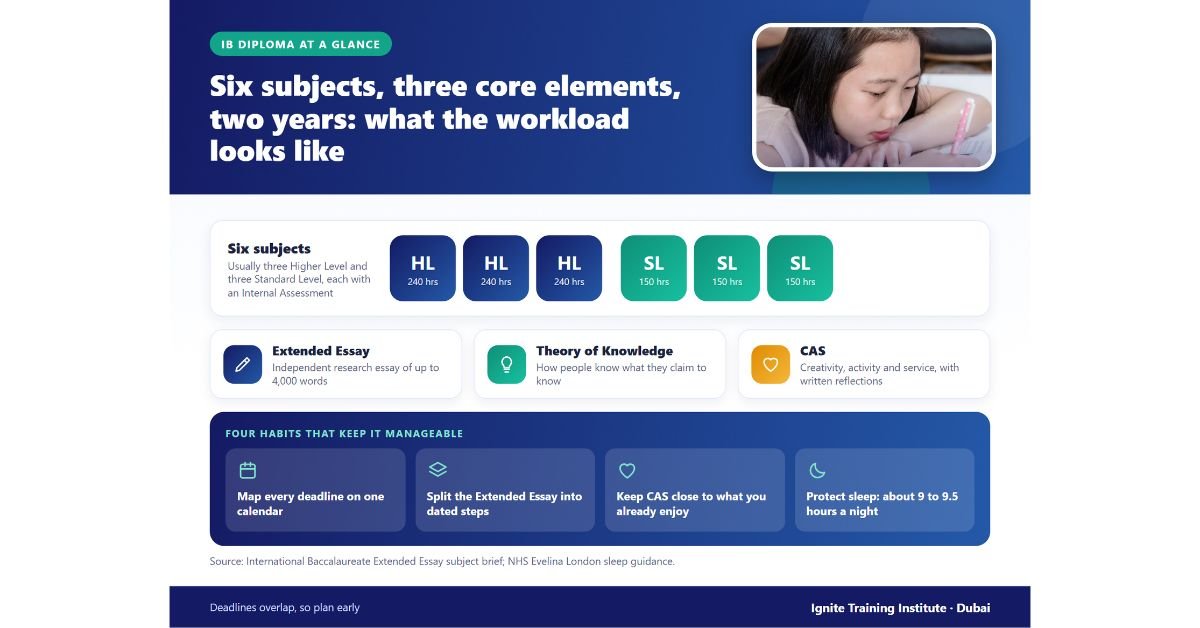
Infographic: the IB Diploma workload at a glance. Source: Ignite Training Institute.
Using CAS as a pressure valve instead of one more task
IB CAS works best when it overlaps with things the student already enjoys. Treated as a box-ticking chore, it becomes another source of IB student stress.
A student who already plays football, volunteers at a weekend community project or plays in a school band can often count these as CAS experiences, provided the school’s CAS coordinator agrees. The activity itself then becomes a genuine break from desk work.
The weak point is usually the written reflection, not the activity. Writing a few lines straight after each session, rather than reconstructing months of experiences later, keeps CAS light. Requirements for evidence and reflection depend on the school, so students should check their coordinator’s expectations early.
Looking After the Student
Protecting sleep, meals and downtime during peak weeks
Sleep is usually the first thing students cut in a heavy week, and it is the cut that costs them most. Protecting a few basics makes every other hour of study more effective.
According to the Evelina London Children’s Hospital, part of the NHS, most teenagers need around nine to nine and a half hours of sleep a night. The same guidance suggests putting phones away at least an hour before bed and avoiding caffeinated drinks after lunch.
In practice, families can agree a few non-negotiables for peak weeks:
- a fixed lights-out time, even on deadline nights
- regular meals eaten away from the desk
- one evening or half-day each week with no schoolwork at all
This is practical advice, not medical guidance. If a student’s stress, sleep or mood is causing real concern, the school counsellor or a doctor is the right first contact.
When extra academic support helps
Outside support helps most when it targets a specific gap, such as a weak HL subject or an IA that has stalled. It helps least when it adds hours to an already full week without a clear purpose.
Two situations come up often. One is a student who copes with most subjects but falls behind in HL Mathematics, where content builds quickly and gaps compound. In that case, an IB maths tutor in Dubai who knows the specific course (Analysis and Approaches or Applications and Interpretation) can help close the gap before mocks. The other is a student who understands the content but struggles to structure IA reports or TOK essays.
Ignite Training Institute, a tutoring centre in Dubai that teaches IBDP and MYP students online and in person, is one example of a provider offering IBDP tutoring in Dubai. Whoever families choose, the rules on academic honesty matter: a tutor can explain concepts and give general feedback, but the EE, IAs and TOK work must remain the student’s own. A good tutor knows where that line sits and stays well on the right side of it.
Tutoring is not always the answer. Sometimes the better move is dropping an extracurricular commitment for a term, or asking the school to adjust a deadline.
The takeaway
The IB Diploma is designed to stretch students across many fronts at once. Families who map every deadline early, break the Extended Essay into steps, keep CAS close to genuine interests and protect sleep give students the best chance of finishing the two years well, and still in good shape.
References
- International Baccalaureate. Extended Essay subject brief.
- Evelina London Children’s Hospital (NHS). Teen sleep guidance.
About the author
Sumit Advani writes about IB education. As Co-Founder of Ignite Training Institute, a tutoring centre in Dubai, he brings over 10 years of education expertise in the UAE. With a B.Sc. in IT and a Diploma in Advertising & PR, he designs personalised academic programmes that help students achieve their goals.
See More Informative Articles On: RESOVENT.COM
